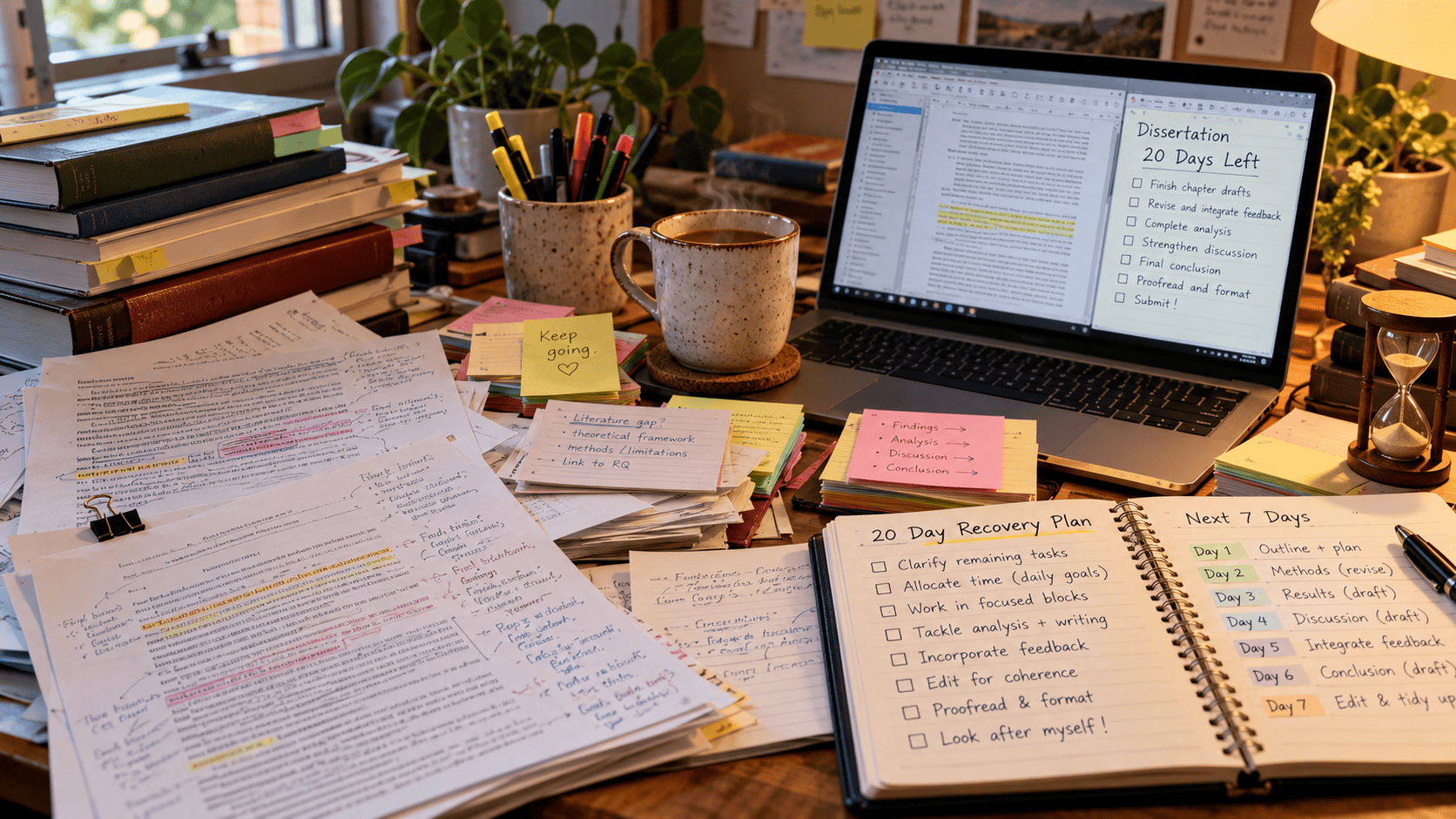

Twenty days before a dissertation deadline is not an ideal time to begin. It is also not automatically a lost cause.
The worst response is usually to spend the next several days worrying about how far behind you are. A better response is to reduce the project to manageable decisions: clarify the research question, contact your supervisor, identify the evidence you actually need, build a realistic structure, and begin writing before the research feels completely finished.
Students often assume dissertation help means paying someone to solve the problem for them. In reality, some of the most useful support may already be available through your university at no additional cost.
Your supervisor, experienced peers, and academic libraries can all help, but they serve different purposes. Knowing what to ask from each one can save valuable time when the deadline is approaching.
Start With Your Dissertation Supervisor, Even if the Relationship Is Difficult
A difficult supervisory relationship can make an already stressful dissertation feel impossible.
Perhaps your supervisor takes longer than expected to answer messages. Maybe the feedback feels vague, critical, or contradictory. You may have submitted several ideas only to see each one questioned. After enough frustration, avoiding the supervisor can begin to feel easier than contacting them again.
That is usually the wrong direction.
A dissertation supervisor is not supposed to write the dissertation for you, but supervision normally includes guidance on the research problem, methodology, relevant literature, structure, progress, and written work.
The University of Edinburgh, for example, describes supervisors as responsible for helping students develop a research plan and timetable, agreeing how supervision meetings will work, meeting regularly, and providing feedback on written work.
Oxford similarly states that dissertation supervision should involve regular meetings, agreed stages of progress, constructive criticism, and reasonable support, while making clear that responsibility for the dissertation ultimately rests with the student.
That final point is easy to overlook.
A supervisor can guide the project, but the student still has to move it forward.
Before Blaming the Supervisor, Check Your Side of the Relationship
Some supervisory problems genuinely arise from poor communication or inadequate support. Others become worse because both parties have different expectations.
Before deciding that your supervisor is the reason the dissertation has stalled, ask yourself a few uncomfortable questions:
- Have you been meeting the deadlines you agreed to?
- Have you repeatedly cancelled or postponed meetings?
- Are you asking for urgent feedback on work that you submitted much later than planned?
- Have you changed your topic, argument, methodology, or research question several times without reaching a decision?
- Have you stopped contacting your supervisor because you are embarrassed about your lack of progress?
If several answers are yes, the relationship may be repairable simply by becoming more consistent.
Oxford’s guidance for postgraduate students specifically advises students to agree a schedule of meetings, prepare adequately, observe deadlines, recognize demands on a supervisor’s time, and take some responsibility for maintaining contact.
That does not excuse a supervisor who consistently fails to provide the support required by a programme. It does mean that the most productive question is usually not, “Who is to blame?” but, “What can I do today to restart the project?”
Send a concise message.
Explain where the dissertation currently stands. Attach a short outline if you have one. Identify two or three specific questions rather than asking for general help. Suggest a meeting time. If the deadline is close, say so clearly.
Specific questions are easier to answer than panic.
What to Do if Your Supervisor Really Is Unavailable
Sometimes the problem is not miscommunication.
A supervisor may be on leave, seriously delayed, or unable to provide adequate guidance. Universities normally have procedures for dealing with supervision difficulties.
Edinburgh’s guidance, for example, says students should actively seek help when problems arise and notify appropriate staff when circumstances are affecting their progress. Its supervision framework also addresses what should happen when a supervisory relationship breaks down.
If repeated reasonable attempts to contact a supervisor produce no response, do not simply wait until the submission deadline.
Check your programme handbook. Contact the dissertation coordinator, programme director, graduate tutor, department office, academic adviser, or another person designated by your institution.
The exact process differs between universities, so your own programme rules should take priority.
An Experienced Friend Can Help, but Use Their Dissertation Carefully
A friend who has already completed a dissertation can be extremely useful.
They understand something that generic study advice often misses: what the process actually feels like.
They may be able to explain how they divided their chapters, organized references, planned their research time, prepared for supervision meetings, or dealt with the point when the project seemed too large to finish.
That kind of practical advice can save time.
A previous dissertation can also be useful as an example of structure. It may show how another student organized a literature review, introduced methodology, presented findings, handled chapter transitions, or formatted references.
But there is an important boundary.
Another student’s dissertation is not a template from which you should copy language, arguments, analysis, or uncited ideas.
Oxford’s current plagiarism guidance states that plagiarism includes presenting ideas or material from another source as your own and specifically notes that unpublished material, theses, and other students’ essays fall within that rule.
Harvard’s guidance makes a related point: reading another student’s work merely because you are stuck can create a risk of unconsciously adopting that person’s ideas. It recommends seeking help with developing your own argument rather than using another student’s paper as a substitute for your own thinking.
Use an older dissertation to understand academic form, not to borrow intellectual content without attribution.
Ask Friends for Process Advice, Not a Ready Made Dissertation
The most useful questions to ask someone who has already completed a dissertation are practical ones.
Ask how they narrowed their topic.
Ask how they decided what belonged in the literature review.
Ask how they organized their notes.
Ask when they stopped researching and started drafting.
Ask how they managed references.
Ask what they wish they had done differently.
If they are willing to read a section of your work, check your university’s rules on peer feedback first. Policies differ.
The goal is to use another person’s experience to improve your own process, not to have someone else perform the assessed work.
Your University Library Is More Powerful Than a General Web Search
Students under severe deadline pressure often make the same mistake: they search the open web for hours while ignoring the academic resources their university already provides.
A university library may give you access to journal databases, ebooks, theses, specialist indexes, archival material, citation tools, and librarians who know how to search them.
That matters because dissertation research is not simply about finding a large number of documents. It is about finding relevant and credible scholarship efficiently.
When twenty days remain, efficiency becomes critical.
Instead of searching broad phrases repeatedly, identify the central concepts in your research question. Create several combinations of keywords. Search recent review articles for terminology. Follow citations backward to foundational studies and forward to more recent research.
Your library catalogue should normally be one of the first places you check because it can show both physical holdings and resources your institution licenses electronically.
Google Scholar Remains One of the Most Useful Starting Points
Google Scholar is still a valuable free discovery tool.
Google states that Scholar searches across scholarly literature including journal articles, theses, books, abstracts, academic repositories, professional societies, universities, and other scholarly sources. It can also help researchers follow citations and locate versions available through a library or elsewhere on the web.
That makes it particularly useful when you need to map a subject quickly.
Search for a highly relevant article, then inspect its references. Use the “cited by” function to locate later scholarship. Search the names of influential authors together with your main topic. Try exact phrases when terminology is distinctive.
Do not assume, however, that every result is automatically available in full text or that every item has equal scholarly value.
Google Scholar is a discovery tool. You still need to evaluate the source.
Google Books Is Useful, but Full Access Is Not Guaranteed
Google Books can be useful when your dissertation requires monographs, older books, historical editions, or specific passages that are difficult to locate quickly.
The original advice that a Gmail account gives access to complete books is incorrect.
Google explains that access depends largely on copyright status and permissions. Public domain books may be available in full. Other titles may offer a limited preview, only small snippets, or bibliographic information without readable pages.
Even when a complete book is unavailable, Google Books can still help you determine whether it contains relevant material before you search your university catalogue, request the book, or look for another legitimate version.
EBSCOhost May Already Be Available Through Your Institution
EBSCO remains an important academic research platform, but access normally comes through a participating university, college, school, public library, or other subscribing institution.
EBSCO states that its research databases include scholarly journals and other academic material, while EBSCOhost provides search tools, citation functions, saved searches, and institutional access to subscribed content.
Before assuming you need to pay for academic articles yourself, sign in through your university library website.
If a database asks for authentication, your institutional account, library login, OpenAthens connection, or campus network may provide access.
If you cannot locate the correct route, ask a librarian.
A five minute conversation with someone who understands your university’s subscriptions can be more productive than an hour spent clicking inaccessible search results.
Questia Should Be Removed From Modern Resource Lists
Older dissertation advice frequently recommended Questia as a large online research library.
That recommendation is now obsolete.
Questia ceased operations in December 2020.
Students searching for a modern replacement should instead begin with their university library, Google Scholar, EBSCOhost where available, discipline specific databases, and dissertation repositories.
ProQuest Is a Major Resource for Previous Dissertations and Theses
If you specifically want to examine previous dissertations, ProQuest Dissertations & Theses Global is considerably more relevant than many older general research websites.
ProQuest says the collection contains more than six million dissertation and thesis metadata records, including millions of full text documents from institutions around the world.
Access to the complete database often depends on an institutional subscription.
ProQuest also makes some dissertation records discoverable through Google Scholar. Open access dissertations can be downloaded freely, while other records may require institutional authentication or offer more limited access.
Your own university may also maintain an institutional repository containing theses and dissertations produced by previous students.
Do not assume every university makes every dissertation publicly downloadable. Access policies differ by institution, author permission, embargo status, copyright rules, and programme requirements.
Do Not Try to Read Hundreds of Sources
Having access to hundreds of references does not mean you should read hundreds of references.
With a close deadline, indiscriminate reading can become another form of procrastination.
Start by identifying the sources most directly related to your research question.
Prioritize:
- Major recent review articles relevant to your field.
- Foundational works repeatedly cited by other scholars.
- Recent research that directly addresses your question.
- Sources required to justify your methodology.
- Evidence you expect to discuss directly in your analysis.
- Literature that disagrees with your emerging argument.
A dissertation is not improved merely by having a longer bibliography.
The sources need to contribute to the research problem.
If You Have Only Twenty Days, Build a Recovery Schedule
A short deadline changes the strategy.
You probably do not have time to explore every possible direction. Scope control becomes more important than ambition.
A practical twenty day recovery schedule might look like this:
Days 1 and 2: Define the Question
Choose the narrowest defensible research question that still meets your programme requirements.
Read the dissertation handbook again.
Confirm the word count, required sections, citation style, submission method, ethics requirements, and deadline.
Contact your supervisor immediately.
Days 3 to 5: Build the Core Literature
Search your university library, Google Scholar, and relevant databases.
Identify the strongest sources rather than collecting everything available.
Create a reference manager library if you have not already done so.
Take notes with page numbers and citation details while you read.
Days 6 and 7: Lock the Structure
Create a detailed chapter outline.
Decide what argument or purpose each chapter serves.
Write down which sources belong in each section.
At this point, avoid changing the entire research question unless there is a serious problem.
Days 8 to 13: Draft the Main Chapters
Write the sections where the research is strongest first.
Do not spend an entire day polishing the opening paragraph.
A rough complete chapter is more useful than one perfect page.
Insert citations as you work rather than planning to reconstruct them later.
Days 14 to 16: Fill the Gaps
Identify missing evidence, weak transitions, incomplete analysis, or sections that still depend on unsupported claims.
Conduct targeted research only for those gaps.
Days 17 and 18: Revise the Argument
Read the dissertation as one document.
Check whether each chapter contributes to the research question.
Remove repetition.
Strengthen evidence.
Make sure the conclusion actually answers the question posed at the beginning.
Day 19: References and Technical Requirements
Check every citation.
Confirm that every item cited in the text appears in the bibliography where your citation style requires it.
Review tables, figures, appendices, page numbering, headings, acknowledgements, and formatting rules.
Day 20: Final Proof and Submission
Proofread the final document.
Do not introduce unnecessary major changes in the final hours.
Confirm the correct file format and submission process.
Leave enough time to upload the document before the deadline.
A technical problem five minutes before submission is a preventable disaster.
Good Dissertation Help Still Requires You to Do the Dissertation
A supervisor can redirect you.
A friend can explain what worked for them.
A librarian can help uncover sources.
Google Scholar can help map the literature.
A dissertation database can show how previous researchers structured similar work.
None of those resources replaces the central task.
The dissertation still has to become your argument, your research decisions, your analysis, and your writing.
That is especially important when time is short. Desperation can make shortcuts seem attractive, but copying another dissertation, buying assessed work, or submitting someone else’s analysis creates a much larger academic problem than being behind schedule.
The most effective form of dissertation help is support that makes you capable of finishing your own work.
If the deadline is close, begin with the people and resources you already have access to, narrow the project, and start writing sooner than feels comfortable.
Twenty days disappear quickly. They are much more useful when spent producing pages than worrying about the pages that do not yet exist.