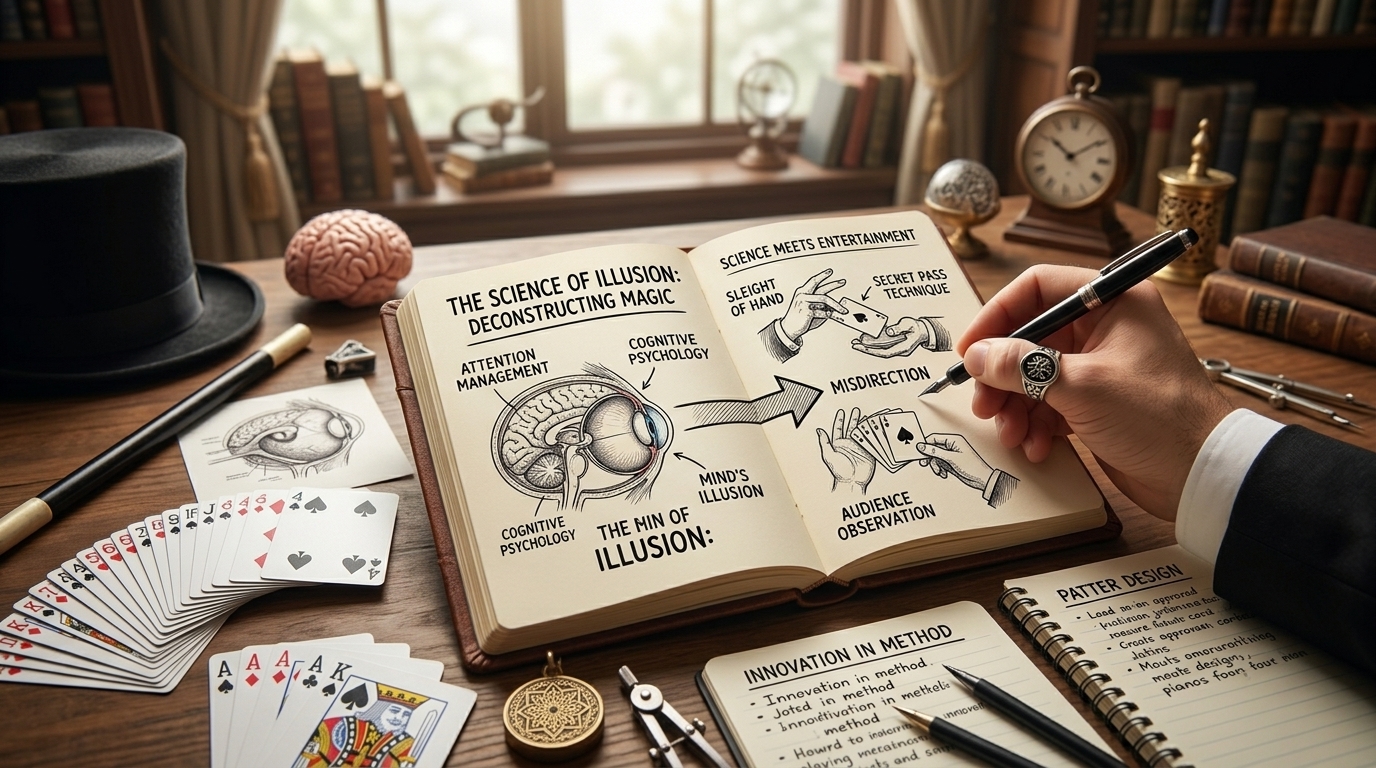

The most impressive magic often happens while the audience is looking directly at it.
A coin vanishes from a hand that never seemed to close. A playing card appears somewhere impossible. An object changes while spectators are convinced they watched every movement. The instinctive explanation is that the magician moved too quickly or simply distracted everyone at the crucial moment.
Professional magic is more sophisticated than that.
Magicians combine physical technique, control of attention, timing, expectation, language, psychology, theatrical structure, and sometimes specially designed props to create an experience that appears impossible.
Three techniques explain a large part of that experience: sleight of hand, misdirection, and the performer’s spoken presentation, traditionally called patter.
They are not the only methods used in magic, and knowing that they exist does not automatically reveal how a particular illusion works. What they show is something more interesting: successful magic depends as much on what the audience thinks is happening as on what physically occurs.
The First Secret Is Sleight of Hand
Sleight of hand is one of the oldest and most recognizable skills in conjuring.
It involves trained movements that allow a performer to manipulate cards, coins, balls, and other objects while making those movements appear ordinary or insignificant.
The popular image is speed. A magician supposedly moves so quickly that the audience cannot see what happened.
That explanation misses much of the skill.
Good sleight of hand often succeeds because the movement does not look suspicious at all.
A false transfer of a coin, for example, is more convincing when it resembles the genuine action of moving a coin from one hand to another. The objective is not necessarily to perform the secret movement at extraordinary speed. It is to make the deceptive action fit naturally into everything around it.
Research on magic has used this difference between genuine and deceptive actions to examine perception and attention. Studies of common sleight techniques have shown that magicians can exploit expectations about how an ordinary movement should look, allowing a deceptive action to be interpreted as something familiar.
That kind of naturalness takes considerable practice.
A published account of intensive sleight of hand training describes techniques that may require months or years of repeated rehearsal before they become sufficiently precise and natural. The training involves much more than learning where an object is hidden. It requires coordination, timing, muscle memory, consistency, and an understanding of how the movement appears from the spectator’s point of view.
Professionals Do Not Rely on Sleight of Hand Alone
A common myth is that beginners use gimmicks while professional magicians rely almost entirely on pure manual skill.
Professional magic does not divide so neatly.
Magicians can use sleight of hand, specially prepared objects, mechanical devices, optical principles, mathematical methods, assistants, electronics, staging, psychological techniques, or combinations of several methods.
Scientific writing on magic describes accomplished performers as using visual illusions, special effects, sleight of hand, secret devices, mechanical apparatus, and cognitive techniques to control what spectators perceive and infer.
A gimmick therefore does not automatically indicate less skill.
The real craft lies in making whatever method is used disappear inside the performance.
A mechanically sophisticated illusion can demand enormous timing and theatrical precision. A simple coin trick can require years of manual practice. Neither category by itself determines whether the magician is a beginner or an expert.
The Second Secret Is Misdirection
Misdirection is probably the most misunderstood principle in magic.
It is often described as distraction: the magician makes the audience look at one hand while the other hand does the secret work.
That happens, but it represents only one form of misdirection.
A more accurate description is management of attention.
The magician creates a hierarchy of importance. One object appears meaningful while another seems irrelevant. One movement feels like the main event while another looks routine. A question, gesture, facial expression, pause, joke, sound, or revelation can change what spectators devote attention to at a particular moment.
The crucial point is that looking and attending are not exactly the same thing.
In experimental research on magic, spectators have sometimes failed to notice a secret action even when their eyes were directed close to the location where it occurred. One eye tracking study found high rates of inattentional blindness during a coin illusion even though the critical movement took place visibly on screen.
Earlier work using a vanishing cigarette illusion produced a similar insight. Spectators could miss a visible action not simply because their eyes were pointing elsewhere, but because their attention had been directed toward something the performer had made more important.
That is much more powerful than ordinary distraction.
The audience can technically see the method and still fail to register its importance.
Magicians Can Direct Attention With Social Cues
Human beings pay enormous attention to other people.
We look where someone else looks. We respond when someone asks us a question. Faces attract attention. Gestures suggest what matters.
Magicians can use those normal social behaviors as part of a performance.
In one study, a magician asked spectators a question while establishing eye contact. This social cue drew attention toward the magician’s face while a visible change occurred elsewhere. Many participants failed to notice the change.
This helps explain why an experienced magician’s gaze and body position can matter so much.
If the magician treats an object as unimportant, the audience may do the same.
If the performer suddenly looks toward something, spectators are likely to follow.
If a revelation has apparently finished the trick, attention may relax at exactly the moment when another concealed action is taking place.
Researchers studying professional magic have even examined whether spontaneous blinking and brief relaxation of attention tend to occur at moments useful to the performer. One experiment found synchronized audience blinking after apparently impossible moments, sometimes coinciding with actions the magician wanted to conceal.
Magic is therefore partly an art of deciding when spectators are mentally ready to notice something and when they are not.
Misdirection Can Also Shape What the Audience Thinks Happened
Attention is only part of the puzzle.
Magic also works by controlling interpretation.
Suppose a performer casually shows a box and describes it as empty. The words do not prove that the box is empty, but they can help establish an assumption about what spectators believe they have seen.
Later, if something appears from the box, the effect feels stronger because the audience remembers an object they had accepted as empty.
This does not mean that simply saying something makes people believe it.
The language works together with timing, gesture, visual information, expectations, and the structure of the trick.
Researchers studying magic describe these effects in terms of attention, memory, causal inference, expectation, and cognitive illusion. The audience is not only watching physical events. It is constantly constructing an explanation of what those events mean.
A strong magician helps build the wrong explanation without making the manipulation obvious.
The Third Secret Is Patter, but It Does More Than Distract
Magicians traditionally use the word patter for the spoken material accompanying a trick.
Patter can include instructions, jokes, questions, storytelling, explanations, character work, or apparently casual conversation.
Older descriptions of magic often treat patter mainly as another form of misdirection. The magician talks so the audience becomes distracted from what the hands are doing.
That explanation is too simple.
Speech can certainly influence attention. Asking a spectator a direct question may cause that person to look toward the performer’s face. A story can shape expectations about what is happening. Humor can change the rhythm of attention. Carefully chosen language can influence the meaning spectators attach to an object or action.
But recent experimental evidence suggests that patter does not automatically make a visual secret harder to notice.
A 2026 study tested whether spoken patter increased inattentional blindness during a Three Card Monte routine. Participants watched versions with matching narration, unrelated narration, or no spoken narration. Researchers found no significant difference in whether participants noticed a subtle visual mark on a card. The authors concluded that patter may not necessarily increase visual misdirection in that routine, while still potentially strengthening emotional engagement, rapport, storytelling, and entertainment.
That distinction matters.
Patter is not simply verbal camouflage.
It is part of the performance.
A Good Script Gives the Trick a Reason to Matter
Consider a magician who places a coin in one hand and makes it disappear.
Without presentation, the audience sees a puzzle.
Add a story, a character, a challenge, humor, or emotional meaning and the same technical effect can become a performance.
Professional magic education increasingly treats scripting as a serious part of the craft. Training in scripting focuses on removing unnecessary language, connecting the presentation to the performer’s character, and thinking about what the audience is experiencing rather than merely narrating physical actions.
This also explains why constant talking is not necessarily good patter.
A magician who describes every visible action can make a trick slower and less interesting.
Effective speech has a job.
Sometimes it provides necessary instructions. Sometimes it establishes an idea. Sometimes it creates humor. Sometimes it builds tension. Sometimes silence is stronger.
The words need to serve the effect.
Assistants Are Part of the Choreography, Not Automatically the Secret
The original image of stage magic often includes several assistants surrounding the magician.
Assistants can certainly play important technical roles in illusions. They may operate apparatus, coordinate movement, help with timing, participate directly in an illusion, or shape where the audience looks.
But their presence does not automatically mean that they are secretly performing the trick.
Stage magic is choreography.
Lighting, music, costume, scenery, movement, assistants, and the magician’s own body can all contribute to what the audience considers important at a particular moment.
A good assistant may therefore be essential even when the audience can see exactly what the assistant is doing.
The method lies not simply in hiding an action, but in making the visible action mean something different from what spectators assume.
There Is No Universal Magician’s Oath
The idea that every magician takes a sworn oath never to reveal a secret is part of magic folklore.
There is no universal oath binding every magician.
Professional organizations do, however, maintain strong ethical traditions around unnecessary exposure.
The Society of American Magicians and the International Brotherhood of Magicians jointly state that members should oppose the willful public exposure of magic principles and methods. Their ethics guidelines also emphasize respecting the rights of creators, inventors, authors, and owners of magical effects and presentations.
The Society of American Magicians, founded in 1902, similarly describes opposition to unnecessary exposure as one of the ideals associated with the organization.
That is different from saying magicians never teach one another.
Magic has a long tradition of books, lectures, clubs, apprenticeships, specialist shops, workshops, and private instruction. Research into professional magicians describes knowledge being transferred within communities of practitioners, historically through direct contact and publications and increasingly through video and online instruction.
The ethical concern is usually not education itself. It is indiscriminate exposure that removes the mystery without contributing to the development of the art.
The Real Secret Is the Combination
Sleight of hand, misdirection, and patter are easier to explain separately than they are to separate during an actual performance.
A magician may perform a secret movement while asking a question.
The question shifts social attention.
The performer’s gaze reinforces where the spectator should look.
The script creates an expectation about what the hands are doing.
A pause establishes the timing.
The audience remembers the apparent action rather than the physical one.
A revelation then arrives at precisely the moment when the spectator’s mental explanation can no longer account for what happened.
That combination is what makes good magic difficult to reverse engineer.
Research into the psychology of conjuring has become valuable precisely because magicians have spent generations discovering practical ways to exploit limits in attention, perception, memory, and expectation. Scientists now use magic effects as experimental tools for studying some of those same processes.
The magician’s hands matter.
So do the words.
So does the audience’s gaze.
But the most important tool may be the spectator’s own mind.
The performer creates the conditions. The audience completes the illusion.