
Three Classic Camera Designs That Shaped Film Photography
Long before digital cameras made photography almost effortless, choosing a camera often meant choosing a particular way of seeing and working. Box cameras emphasized simplicity, folding cameras combined portability with larger film formats, and rangefinder cameras introduced a more precise method of focusing.
These three designs served different photographers and different needs. Understanding how they worked also explains why some of these old cameras remain interesting to film photographers today.
Box Cameras Made Photography Simple
For much of the early 20th century, the box camera was one of the most accessible ways for ordinary people to take photographs. Kodak played a major role in this shift. The company introduced its first commercial transparent roll film in 1889, followed by the $1 Brownie camera in 1900. The Brownie helped make photography affordable to a much wider audience.
The appeal was straightforward: box cameras were generally inexpensive, uncomplicated, and easy to operate. Many models used relatively simple lenses and offered only limited control over focusing, aperture, and shutter speed. That simplicity reduced the number of decisions the photographer had to make.
It also did not mean that every box camera produced poor photographs. Under suitable lighting and at appropriate distances, simple cameras could produce surprisingly effective images. Their success came partly from making photography accessible rather than from offering extensive technical control.
The design was also practical. A box shaped body protected the film and camera mechanism, while the photographer could compose a picture through a simple optical finder before releasing the shutter.
For beginners, families, and casual photographers, the box camera was less about technical experimentation and more about making the process easy enough that almost anyone could take a picture.
Folding Roll Film Cameras Added Portability and Control
Folding roll film cameras offered a different solution to the same problem: how to make a capable camera easier to carry.
Kodak introduced the Folding Pocket Kodak in 1898, a camera that became an important early example of the folding roll film design. Kodak describes it as an ancestor of modern roll film cameras, and its 2.25 by 3.25 inch negative size became an important format for many years.
Unlike a simple box camera, a folding camera typically used a bellows system. When the camera was opened, the lens and front standard extended away from the film body. When it was closed, the bellows and lens assembly folded into the camera, substantially reducing its size for storage and transport.
This was one of the design’s greatest advantages.
Folding cameras were produced in many formats and levels of sophistication. Some were relatively simple, while others included better lenses, more elaborate shutters, focusing mechanisms, and larger film formats. Because models varied considerably, it is more accurate to think of the folding camera as a broad family of designs rather than a single standardized camera type.
The larger negatives available from many roll film cameras were another attraction. Larger film formats could provide substantial detail and tonal information, although the final result still depended on the lens, film, exposure, focusing, and processing.
The combination of a relatively large negative and a collapsible body made folding cameras particularly practical for photographers who wanted more capability without carrying a permanently extended camera.
Rangefinder Cameras Changed the Way Photographers Focused
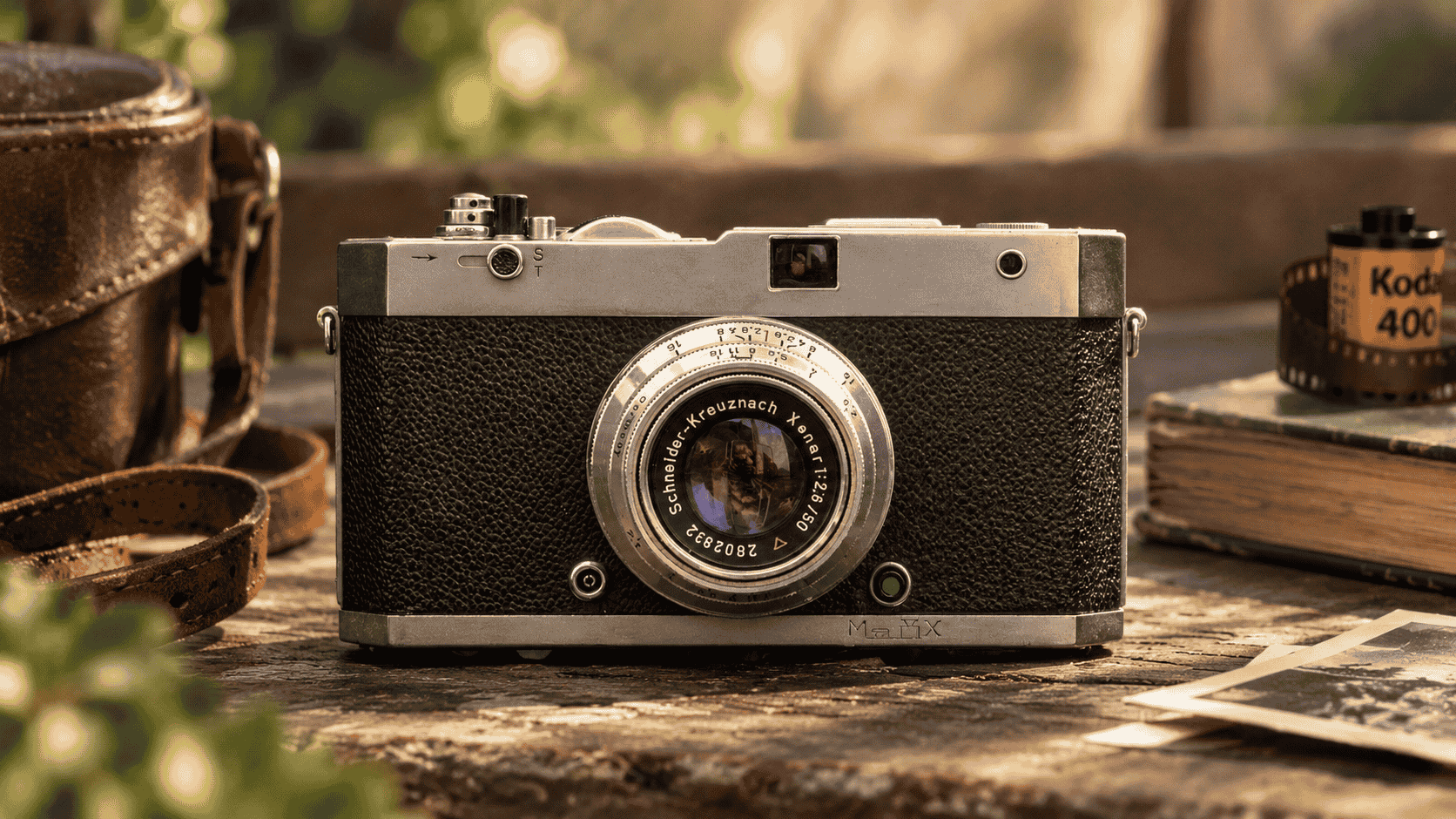
The third design is best described more precisely as a rangefinder camera, rather than simply a “viewfinder camera.”
A viewfinder is the system used to compose an image without looking directly through the taking lens. A rangefinder camera adds a separate distance measuring and focusing mechanism to that arrangement.
Its most distinctive feature is the way it combines two views of the subject. In a traditional rangefinder, the photographer sees a secondary image superimposed over the main view. Turning the focusing ring moves that image. When the two images align correctly, the lens is focused at the corresponding distance. Leica describes this as a superimposed image focusing system.
The system offered photographers a precise way to focus manually, including in relatively low light. It could also be fast and discreet because the photographer did not need to raise a large reflex mirror or use a through the lens reflex viewing system.
Another characteristic is the presence of separate windows on the front of the camera. One is associated with the viewfinder and another with the rangefinder mechanism. On many classic rangefinder cameras, these windows are immediately visible and are one of the easiest ways to distinguish the design.
Rangefinder cameras also have an important compositional difference from single lens reflex cameras. The photographer is not looking directly through the taking lens. Instead, the optical viewfinder provides a separate view, often with frame lines indicating the area that will be recorded. Some modern rangefinder systems also incorporate parallax compensation to account for the difference between the viewfinder position and the lens position.
This design has remained relevant well beyond the era of classic film photography. Leica’s M system, for example, continues to use a mechanical rangefinder focusing system, demonstrating that the concept has remained useful even as photographic technology has changed.
Which Design Makes Sense for a Photographer?
The answer depends less on which camera is technically superior and more on what the photographer wants from the experience.
Box cameras are appealing for their simplicity. They are straightforward, historically important, and well suited to photographers who enjoy the limitations and character of uncomplicated film photography.
Folding roll film cameras offer a combination of portability and larger film formats. They are particularly interesting to photographers who enjoy the mechanics of older cameras and want the visual characteristics associated with medium and larger roll film formats.
Rangefinder cameras are built around a different shooting experience. Their separate viewfinder and precise manual focusing system can be useful for photographers who value compact equipment, discreet operation, and deliberate focusing.
These categories also overlap. A folding camera can have a viewfinder, for example, while not being a rangefinder. Likewise, not every camera with a separate viewfinder uses a rangefinder focusing system.
That distinction is important when comparing classic cameras. The body shape tells only part of the story. The lens, film format, focusing mechanism, shutter, and available controls can vary significantly from one model to another.
Classic Cameras Still Have Something to Teach Photographers
The appeal of these cameras is not simply nostalgia. Each design reflects a different approach to photography.
The box camera reduced photography to its essentials. The folding camera demonstrated how engineering could make a larger format camera easier to carry. The rangefinder introduced a sophisticated focusing method while retaining a relatively compact body.
For anyone exploring film photography, trying different camera designs can be an excellent way to understand how equipment influences the way photographs are made.
The best approach is simple: experiment. Change your angle, pay attention to the available light, learn how your camera responds, and spend time understanding its limitations. Sometimes, a camera with fewer controls can encourage more thoughtful photography.