
For me, the argument begins with a single word: arrested.
I have never described what happened to me in Jerusalem in January 1996 that way. I was questioned, detained, held in the Russian Compound and eventually deported from Israel. Contemporary accounts sometimes used the word arrested, while my own account has consistently emphasized detention and the fact that I was not ultimately prosecuted for the alleged plot that first drew the attention of Israeli security authorities.
That distinction matters to me because the allegations were grave.
In early January 1996, Israel’s General Security Service sought my deportation amid suspicions concerning an alleged plot against Al Aqsa Mosque. A contemporary chronology published by the Journal of Palestine Studies, citing United Press International and Foreign Broadcast Information Service reporting, recorded that the Shin Bet had requested the deportation of American David Ben Ariel, a member of the Temple Mount Faithful, in connection with allegations involving a plot against the mosque.
I denied involvement in any such plot then, and I have continued to deny it ever since.
The Days That Changed Everything
My recollection is that the confrontation with the authorities unfolded over several days.
I underwent an initial interrogation that lasted about six and a half hours. Afterward, I was instructed to return to the police repeatedly. I complied.
Then came the deportation order.
I remember the officer who delivered it as a man named Moshe, someone who had treated me decently during an ordeal that otherwise felt increasingly unreal. When the document was placed in my hands, I refused to sign it. I dropped it to the floor.
That moment remains vivid because, to me, signing it would have meant accepting the government’s case against my continued presence in Israel.
The surviving public record does contain an important chronological conflict that should not be hidden. My later account places the decisive detention on January 9. Contemporary reporting summarized by the Journal of Palestine Studies places my detention or arrest several days earlier, on January 4. January 9, 1996 was also a Tuesday, not a Monday as I later wrote in recollections of the episode.
The exact sequence therefore deserves caution. What is clear is that by early January I was in Israeli custody and that the authorities were pursuing my removal from the country.
Inside Jerusalem’s Russian Compound
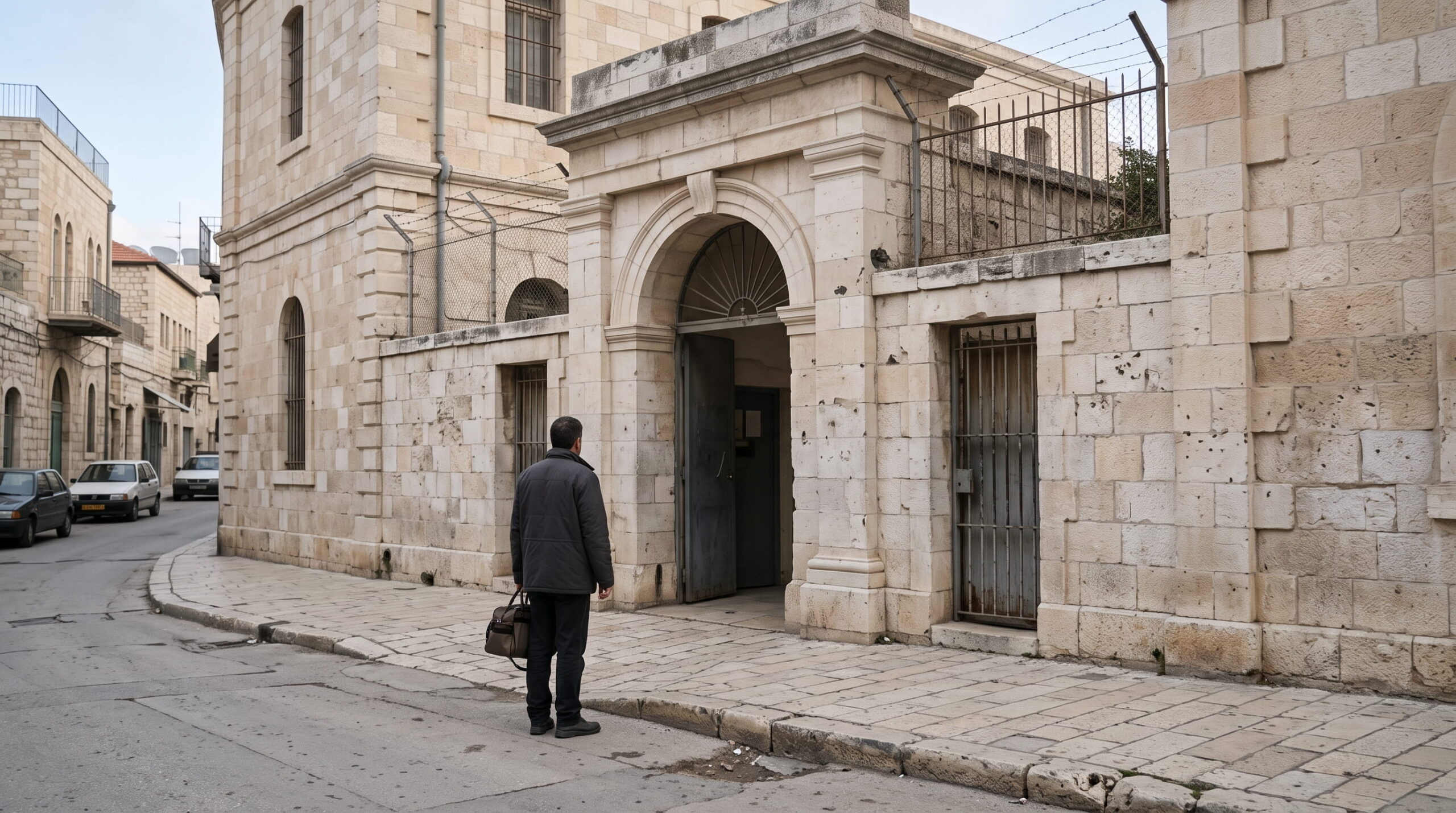
I was taken to the Russian Compound in central Jerusalem.
My memories of the place are difficult to separate from the physical conditions. I remember extreme crowding. At one point, I counted twenty one men in a cell intended for far fewer people. Men slept on mats across the floor. I remember insects crushed against the walls and other detainees carrying marks from bites.
Sanitation was primitive. The toilet was little more than an opening in the floor. A shower pipe emptied above the same area. Toilet paper could become something detainees had to ask repeatedly to receive.
Those details are my recollection, and I cannot independently prove every individual feature of the cell almost three decades later.
The broader description of severe overcrowding, however, has substantial contemporary corroboration.
The United States State Department’s 1996 human rights report described dilapidation and serious overcrowding at the Russian Compound. It reported that as many as 50 Palestinian detainees had been held in cells designed for four beds. The report also said the government was making limited renovations to the facility.
A State Department report covering 1995 similarly cited an Association for Civil Rights in Israel report describing overcrowding at the facility, including as many as 50 detainees in a four bed cell.
The criticism did not end there. After visiting the facility in 1997, then High Court of Justice President Aharon Barak was reported as saying the Russian Compound was “not fit to serve as lock up.”
My description of the place as a dungeon was emotional language born from my experience. The documented record nevertheless shows that serious concerns about crowding and detention conditions were not mine alone.
One Historical Detail I Got Wrong
There is one detail from my original account that requires correction.
I wrote that the Russian Compound had been built hundreds of years earlier by the Turks.
It was not.
The compound was developed by Russians during the Ottoman period to accommodate Russian pilgrims visiting Jerusalem. The building later used as the Jerusalem detention center was constructed by the Russians in 1864 as the Elizabeth Men’s Guesthouse, according to Israel’s Council for Conservation of Heritage Sites. It was subsequently converted to police and detention use.
The distinction does not change what happened inside the facility, but historical accuracy matters.
From the Magistrate to the High Court
My detention became a legal fight.
I was represented by Israeli attorney Naftali Warzberger. I have also stated that the Temple Mount Faithful supported my legal defense.
My case eventually reached Israel’s High Court of Justice.
Over the years, I described the High Court proceeding as confirmation that there was no reason to continue holding me because I presented no flight risk. The surviving material I was able to locate calls for more precise wording.
A later reproduction attributed to The Jerusalem Post reported that the High Court rejected my petition against continued imprisonment after the state said it was prepared to expel me immediately, which made further detention unnecessary.
That is significant, but it is not identical to a judicial finding that my previous detention had been unlawful.
The available sources establish that there was a High Court challenge to my continued confinement and that deportation overtook the question of continued detention. I have not located the original court judgment in a form that would justify making a stronger legal claim.
Why the Temple Mount Was at the Center of the Dispute
My involvement with the Temple Mount Faithful cannot be treated as incidental.
The movement, led at the time by Gershon Salomon, openly advocated rebuilding a Jewish Temple on the Temple Mount. Its activities had already generated considerable controversy before my detention.
Only months before my case, in September 1995, the Temple Mount Faithful petitioned Israel’s High Court for permission to pray on the Temple Mount during Jewish holidays. The Jewish Telegraphic Agency reported that the movement sought restoration of the Temple and that Israeli authorities had repeatedly restricted its activities because of security concerns surrounding the site.
Salomon publicly promoted rebuilding the Third Temple. In March 1996, shortly after my deportation, he was reported speaking in the United States about that goal and the religious meaning he attached to it.
To understand why Israeli security officials regarded rhetoric about removing the Islamic shrines as exceptionally sensitive, one also has to understand the recent history of the site. In October 1990, violence surrounding a planned Temple Mount Faithful cornerstone demonstration ended with 17 Palestinians killed by Israeli security forces and many others injured.
That history does not prove that I participated in a criminal plot.
It does explain why statements concerning Al Aqsa Mosque, the Dome of the Rock and the rebuilding of a Jewish Temple could attract immediate security attention.
Belief Is Not the Same Thing as Proof of a Criminal Plot
My own position was religious as well as political.
I believed that the Temple had profound importance in biblical prophecy and in Israel’s spiritual future. I mourned its absence. I believed that questions surrounding the Temple Mount should be openly debated rather than treated as subjects people were forbidden even to discuss.
The Jerusalem Talmud contains the teaching I invoked in my original account. In Yoma 1:1, it states that a generation in which the Temple is not rebuilt is regarded as though it had destroyed it. The wording varies somewhat among English translations, but the underlying passage is genuine.
None of that, by itself, establishes participation in a plan to attack a mosque.
Religious conviction, political advocacy and criminal conduct are different categories. A government may investigate a credible security threat, particularly at a location as sensitive as the Temple Mount and Haram al Sharif. An allegation, however, is still an allegation until supported by evidence.
The public sources I located establish that Israeli security authorities investigated me and sought my deportation amid allegations connected to a possible plot against Al Aqsa Mosque. They establish that I was confined and subsequently expelled. I did not find evidence in the sources reviewed for this article that I was convicted of participating in such a plot.
That distinction should remain explicit.
Was It Political and Religious Persecution?
I experienced the episode as political and religious persecution.
I believed my association with the Temple Mount Faithful, my published views concerning Jerusalem and my religious convictions had made me a target. I believed then that the authorities were reacting not to something I had done, but to what they feared I believed.
That remains an interpretation rather than an independently established fact.
The available record demonstrates the investigation, security allegations, detention, court proceedings and deportation. It does not, by itself, prove that officials acted principally because of partisan hostility or religious animus.
There is also an important distinction between what Israeli officials apparently suspected and the administrative basis later given for my removal. In material I subsequently published, I reproduced correspondence attributed to the United States Consulate General stating that the Israeli government deported me for overstaying my authorized period of stay. That correspondence has not been independently authenticated in the primary State Department archives during this review, so it should be presented as part of my documentary record rather than treated as conclusively verified government evidence.
What Israel’s Menorah Meant to Me
One image remained particularly powerful throughout the ordeal: Israel’s state emblem.
The menorah is not an invented connection to Jewish history. Israel’s official emblem consists of a seven branched menorah, olive leaves on either side and the word Israel beneath it. Israeli government material explains that the menorah was modeled on the ancient image associated with the Temple and that the olive branches symbolize peace.
To me, the menorah carried an additional religious meaning. I saw it as a reminder of the Temple, biblical history and what I believed Israel’s spiritual calling should be.
That interpretation was mine. It should not be confused with an official declaration that the modern State of Israel is committed to constructing a Third Temple.
There is a difference between a national symbol’s documented historical origins and the theological conclusions an individual draws from it.
Nearly Thirty Years Later, the Central Question Remains
I can still ask the questions that mattered to me then.
Should a person be treated as dangerous merely for loving Israel, believing biblical prophecy or hoping for a future Temple?
At the same time, any serious retelling has to acknowledge the other side of the equation. Al Aqsa Mosque and the Temple Mount are among the most religiously and politically sensitive places on earth. Israeli authorities had reason to investigate credible allegations of plans for violence there, particularly after earlier episodes demonstrated how rapidly events at the site could become deadly.
The issue is therefore not whether security authorities had a right to investigate.
The enduring question is what evidence existed against the individual they investigated, what conduct could actually be proved and whether the response was proportionate to that evidence.
My answer has always been that I was never part of a plot to blow up Al Aqsa Mosque.
The historical record confirms that such allegations surrounded my detention and that I was deported. It also shows that the Russian Compound in which I was held had documented and serious problems with overcrowding and detention conditions. What the sources reviewed here do not establish is a criminal conviction proving that I participated in the plot attributed to me.
For a story that has followed me for decades, that distinction remains the one I consider most important.