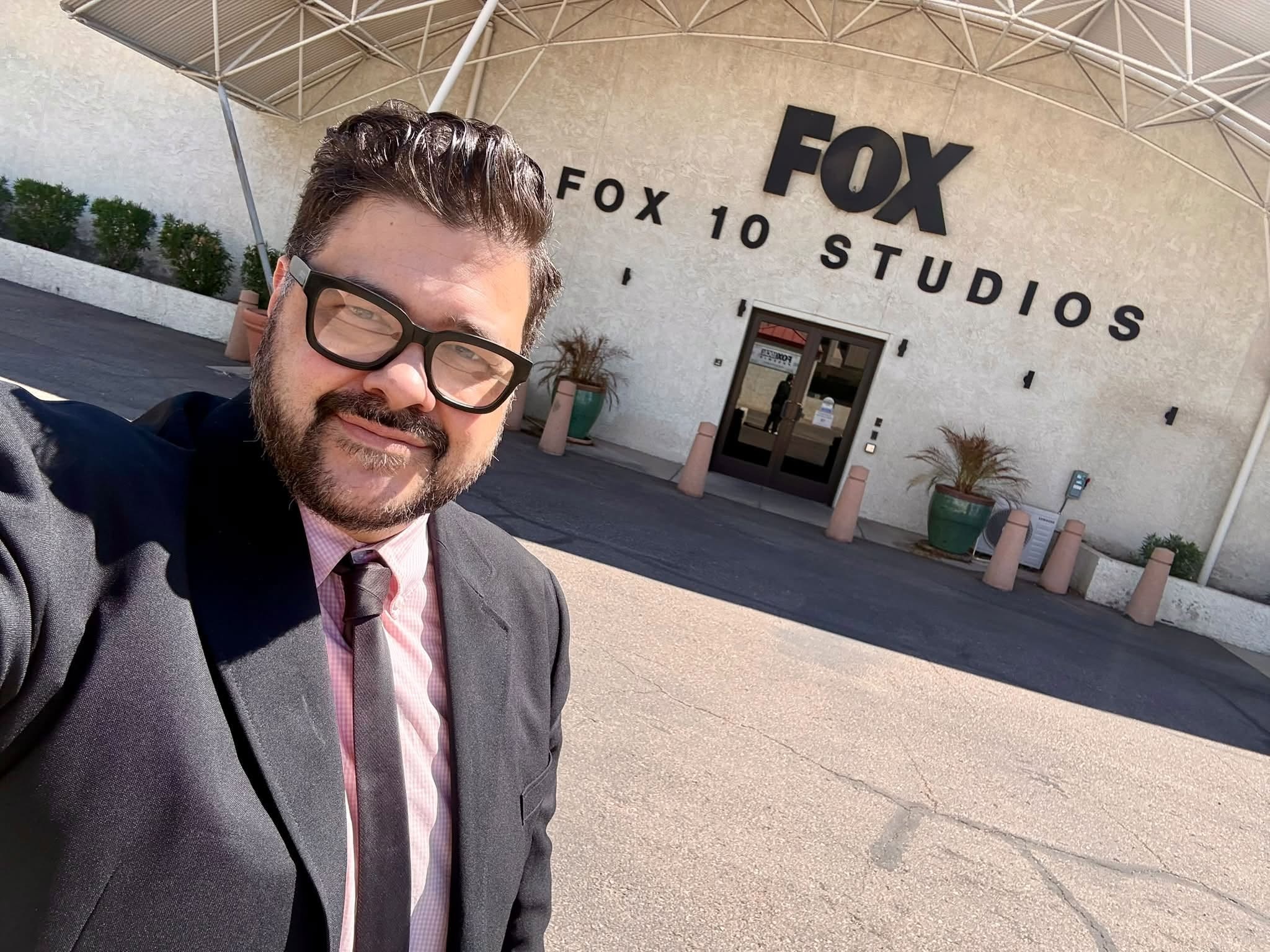

How a production professional, celebrity publicist, and relentless network-builder turned access into a career spanning entertainment, radio, publicity, and digital media
In entertainment, access can be as valuable as talent.
Knowing the right people may open a door, but building a career from those relationships requires something harder to sustain: timing, persistence, credibility, and an instinct for what will make people pay attention.
For Domenick Nati, those qualities have defined a professional journey that has moved through television production, celebrity publicity, radio, digital media, and personal-brand strategy.
Known professionally as a celebrity interviewer and entertainment publicist—and often by the self-styled nickname “The King of Contacts”—Nati has spent much of his career operating at the intersection of celebrities and the media that covers them.
His path did not begin behind a radio microphone.
It began behind the scenes.
Learning the Entertainment Business From the Inside
Born in Buffalo, New York, Nati entered the entertainment industry through production rather than celebrity journalism.
During the mid-2000s, after relocating to Charlotte, North Carolina, he began pursuing opportunities in television and film production. His early professional credits would eventually include work connected with productions such as Talladega Nights: The Ballad of Ricky Bobby, along with television projects including Beauty and the Geek and other unscripted entertainment programming.
Those experiences placed him inside an industry where success often depends as much on initiative and relationships as formal job descriptions.
Nati has described one early experience as particularly formative. While looking for production work, he learned that a major film project was being staffed in Charlotte. Rather than simply forwarding a résumé and hoping for a response, he sought out the production office directly.
The episode became representative of a broader philosophy he would carry throughout his career: opportunity is rarely passive.
Production work also exposed him to the mechanics of entertainment from the opposite side of the spotlight. Cameras, producers, talent, booking, schedules, publicity, networks, and media relations all form part of the same ecosystem. Understanding how those pieces interact would later become one of Nati’s most useful professional advantages.
The Move Into Public Relations
The transition from production into publicity developed gradually.
Nati has said that while working in television, he wrote a press release for one of his projects and distributed it to local news organizations. When the story attracted television coverage, he recognized something important: he was not only interested in creating entertainment—he understood how to generate attention around it.
That realization redirected his career.
In 2006, he established Nati Celebrity Services, a public-relations business focused on entertainment personalities, artists, athletes, and other public figures.
The company became the platform through which Nati built much of the network that would eventually support his work as an interviewer.
Publicity requires a distinctive skill set. A successful publicist has to understand not simply what a client wants people to hear, but what reporters, producers, editors, and audiences are actually willing to cover.
That difference is critical.
Nati’s work increasingly centered on transforming personalities, announcements, controversies, and entertainment developments into stories that media outlets considered worth publishing.
Among his more documented early celebrity-publicity relationships was work involving rapper DMX. During the early 2010s, Nati Celebrity Services appeared in media coverage relating to the artist’s representation, touring, and public statements.
It provided visible evidence that Nati had moved beyond local production work and into national entertainment publicity.
Building a Career Around Relationships
Long before the phrase “personal brand” became standard business language, Nati was building one around his ability to connect people.
Hence the nickname:
“The King of Contacts.”
The phrase is deliberately promotional, but it also captures the central mechanism behind his career.
Public relations, booking, entertainment journalism, and celebrity media all depend heavily on relationships. A contact list by itself has little value. The real asset is knowing whom to call, when to call them, what they need, and how to create a reason for them to respond.
By the middle of the 2010s, Nati had accumulated enough entertainment relationships that the next stage of his career emerged almost naturally.
Instead of only arranging interviews for other people, he began conducting them himself.
The Birth of The Domenick Nati Show
In 2016, The Domenick Nati Show launched as a celebrity interview program.
The move fundamentally changed Nati’s position within the entertainment ecosystem.
A publicist usually operates behind the talent.
A host becomes part of the story.
Nati brought to the show an advantage many new interviewers spend years trying to acquire: direct access to public figures.
His background in publicity meant he already understood booking, media cycles, headline construction, and the kinds of questions capable of generating secondary coverage.
The result was a format built around relatively direct celebrity conversations, often focused on subjects guests would not necessarily encounter during conventional promotional interviews.
The program’s branding reflected that philosophy:
“Maximum Exposure. Minimum Censorship.”
It was less interested in polished publicity conversations than in moments that could become stories of their own.
That approach would become both the show’s defining strength and its most frequent source of controversy.
When Interviews Become Headlines
Nati’s interviews began regularly escaping the boundaries of his own program.
Comments made by guests were subsequently reported by national entertainment and news organizations, demonstrating one of the most important measures of influence for an interview-based show: other media outlets considered the material newsworthy.
An interview with Mama June Shannon, for example, generated coverage after she discussed paying for weight-loss and cosmetic procedures.
Wynonna Judd attracted headlines after responding to questions about Blake Shelton and drinking.
Poker stars Phil Hellmuth and Daniel Negreanu generated coverage from the poker press after discussing professional and political topics.
Duane “Dog the Bounty Hunter” Chapman attracted national attention after discussing high-profile criminal cases.
Actor Daniel Baldwin appeared during the aftermath of the fatal shooting on the set of Rust and defended his brother, Alec Baldwin, in comments that were subsequently reported by major entertainment outlets.
Comedian Cedric the Entertainer discussed Dave Chappelle, comedy, and so-called cancel culture.
Across these interviews, a pattern emerged.
Nati was increasingly producing not simply celebrity conversations, but source material for the wider entertainment-news cycle.
The Question That Changes the Interview
Nati’s interviewing reputation has frequently depended on his willingness to ask questions many traditional celebrity interviewers might avoid.
That strategy has created memorable moments—but also criticism.
One of the most widely discussed examples came during his interview with Christian singer Lauren Daigle in 2018.
Nati asked Daigle whether she believed homosexuality was a sin.
Her response—that she could not honestly answer the question one way or another because she was not God—triggered significant discussion across Christian media and religious communities.
Some critics argued that the question had been designed to place the singer in an impossible position.
Nati rejected the suggestion that he had deliberately set a trap, instead maintaining that difficult and provocative questions were consistent with the established format of his program.
The controversy illustrates a fundamental tension within celebrity journalism.
A promotional interview protects the guest.
A journalistic interview challenges the guest.
Entertainment media increasingly occupies an uncomfortable space between those two objectives.
Nati has generally positioned himself closer to the second.
A Career Built for the Viral Era
The timing of The Domenick Nati Show also proved significant.
The program developed during a period when celebrity media was undergoing a structural transformation.
For decades, national exposure required access to television networks, magazines, newspapers, and major radio stations.
Social media changed the equation.
A sixty-second interview clip could suddenly travel farther than an entire broadcast.
A provocative quote could become a headline within minutes.
A personality could build an audience without waiting for traditional media to grant permission.
Nati’s professional background made him particularly suited to that environment.
He understood traditional publicity, but he also recognized that the internet was rapidly reducing the power of traditional gatekeepers.
His own career increasingly reflected that shift.
The interviewer, publicist, and content creator were no longer separate identities.
They could exist inside the same person.
The Todd Chrisley Interview and the Unexpected Life of a Quote
One of the more unusual examples of this dynamic involved reality television personality Todd Chrisley.
During an appearance on Nati’s show, Chrisley discussed his tax situation and the amount he said he paid annually in federal taxes.
Years later, as Chrisley’s financial and legal problems received national attention, those earlier remarks resurfaced in reporting surrounding the case.
It demonstrated something journalists understand well:
An interview does not end when the broadcast ends.
Once a public figure makes a recorded statement, that statement becomes part of the public record.
Its significance may not become clear until years later.
For Nati, the episode provided an unexpected example of how entertainment interviews can intersect with more consequential public reporting.
Publicist and Interviewer: A Deliberate Contradiction
There is an inherent contradiction in Nati’s professional identity.
Publicists are generally hired to control narratives.
Interviewers are supposed to challenge them.
Nati has worked on both sides.
That duality may explain much of his effectiveness.
A publicist understands how talent is coached, what subjects are sensitive, what questions representatives hope journalists will avoid, and how a seemingly harmless answer can become tomorrow’s headline.
An interviewer possessing that knowledge has an unusual advantage.
He knows where the boundaries are.
He also knows exactly what happens when he crosses them.
Beyond Celebrity Radio
By the middle of the 2020s, Nati’s professional focus had broadened again.
His work increasingly encompassed digital marketing, media strategy, content development, personal branding, audience growth, and consulting.
That evolution reflects a broader change inside the publicity industry itself.
Traditional PR once revolved primarily around press releases, journalists, television bookings, magazine coverage, and red-carpet access.
Modern publicity is far more fragmented.
A brand may now need simultaneously to understand:
social media,
short-form video,
podcasts,
earned media,
creator partnerships,
personal branding,
search visibility,
and direct audience development.
Nati’s more recent work has increasingly emphasized those interconnected channels.
The underlying strategy, however, remains remarkably similar to the one that shaped his early career.
Attention must first be earned.
Then it must be converted into opportunity.
Numbers, Claims, and the Importance of Context
Like many media personalities, Nati’s public profile contains statistics and superlatives that require careful context.
His program has at various times been promoted as “the most media-covered radio show in America.”
That description originated as a promotional claim rather than an independently audited industry ranking.
Similarly, recent profiles have credited his content with more than 100 million digital views, while Nati has discussed conducting hundreds of celebrity interviews.
Those numbers may accurately reflect cumulative reach, but they should be understood as self-reported or promotional figures unless independently audited.
The more meaningful evidence of his media footprint is easier to establish.
Major outlets have repeatedly reported statements originating from his interviews.
That documented secondary coverage provides a tangible measure of the show’s ability to generate stories beyond its own audience.
Understanding the Modern Media Operator
The most interesting aspect of Domenick Nati’s career may be that it does not fit neatly inside a single profession.
He has worked behind cameras and in front of microphones.
He has promoted celebrities and questioned them.
He has helped clients control media narratives while simultaneously building a show designed to produce unpredictable answers.
And as entertainment media shifted toward digital platforms, his career shifted with it.
That adaptability matters.
The modern entertainment professional rarely succeeds by mastering only one channel.
Production, publicity, social media, interviewing, branding, and content distribution increasingly overlap.
Nati’s career reflects that convergence.
What began as a pursuit of production jobs became a public-relations business.
The PR business produced a network.
The network created access.
The access created a radio show.
The radio show created headlines.
And those headlines eventually became the foundation for a broader media and marketing identity.
The Value of Being in the Room
Domenick Nati’s story is ultimately less about celebrity proximity than about what someone does once proximity has been achieved.
Entertainment history is crowded with people who briefly gained access to famous names.
Far fewer converted that access into a sustainable professional infrastructure.
For nearly two decades, Nati has repeatedly repositioned himself as the media environment around him changed—from production professional to publicist, from publicist to interviewer, and from interviewer to a broader digital-media strategist.
His career offers a useful illustration of how modern entertainment influence is constructed.
It is rarely one breakthrough.
It is the accumulation of relationships, timing, persistence, visibility, and the ability to recognize when an industry is changing.
In Nati’s case, perhaps the most appropriate description of his career is also the simplest:
He learned how to get into the room.
Then he learned how to make the conversation inside it matter.