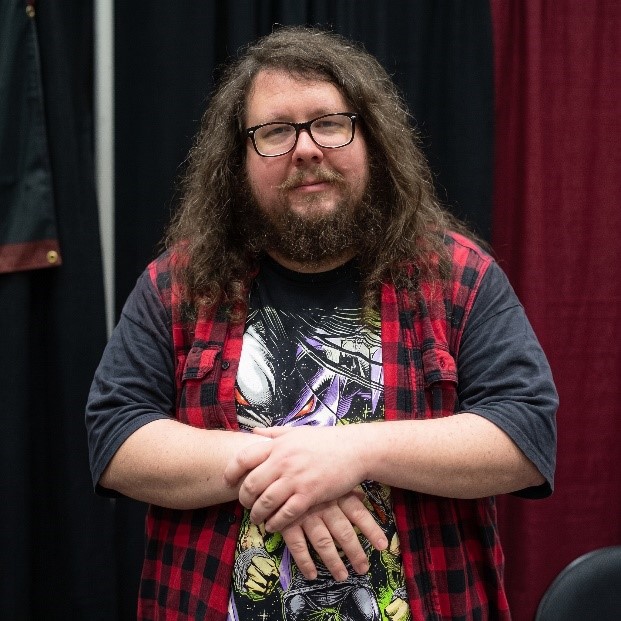
Through comics, wrestling, collectibles, convention floors, and a microphone, the Dallas-based creator behind It’s Pronounced Natedigad has built a distinctly personal place within modern pop culture fandom.
Some media personalities build their careers around distance.
They interview from studios, observe culture from the outside, and report on communities without necessarily becoming part of them.
Bacon Nate Townsend has taken almost the opposite approach.
Known online as natedigad, the Dallas-based podcaster has built his public identity inside the culture he talks about. Comic books, professional wrestling, action figures, movies, convention exclusives, fan events, and the personalities surrounding them are not merely topics on a programming schedule. They are part of the environment in which his show exists.
That distinction has helped make It’s Pronounced Natedigad feel less like a conventional entertainment program and more like an ongoing conversation among people who genuinely care about the same things.
Since launching the podcast in January 2020, Townsend has developed an archive spanning more than 90 episodes and several years of changing interests, road trips, convention experiences, interviews, collecting stories, predictions, recommendations, and deliberately informal conversations.
The result is a show whose identity is inseparable from the personality behind it.
A Podcast Built Around Personality
It’s Pronounced Natedigad does not attempt to disguise itself as highly polished broadcast journalism.
That is part of its character.
Townsend’s episodes have frequently embraced a loose, conversational format. Some are recorded while traveling. Others revolve around conventions, comics, wrestling events, recent movies, collectibles, or whatever happens to be occupying his attention at the time.
There are recurring jokes about delayed episodes, misplaced equipment, forgotten topics, and the unpredictability of getting something recorded at all.
Rather than weakening the program, that informality gives it a recognizable voice.
Townsend does not sound like someone presenting fandom from behind a desk.
He sounds like someone living inside it.
That distinction is important in an era when audiences increasingly gravitate toward creators whose enthusiasm feels participatory rather than manufactured.
For Townsend, the podcast became less about establishing himself as an authority standing above a community and more about becoming another recognizable voice within it.
From Comics to Convention Floors
Comic books quickly became one of the show’s recurring foundations.
Early episodes included a segment titled “natedigad has issues,” in which Townsend discussed newly released comics and highlighted personal recommendations.
Marvel, DC, major crossover events, individual creators, and weekly releases all found their way into the program.
But as the show evolved, comics increasingly became connected with something larger:
convention culture.
Events such as C2E2, Fan Expo Dallas, Fan Expo Denver, Comicpalooza, and San Diego Comic-Con began appearing repeatedly throughout the podcast archive.
The shift changed the show’s energy.
Instead of simply discussing pop culture after the fact, Townsend increasingly took the audience into the spaces where that culture was happening.
Convention recaps became part travel diary, part fan commentary, part interview platform, and part collector’s journal.
The format suited him.
For someone whose public identity is grounded in enthusiasm, conversation, and relationships, convention floors offered a more natural environment than a formal studio ever could.
San Diego Comic-Con and a Growing Convention Identity
Among the events documented throughout Townsend’s public work, San Diego Comic-Con occupies a particularly visible place.
The podcast has featured conversations recorded at SDCC, including interviews with actress Jackie Dallas and recurring guest Ming Chen.
His connection to the convention eventually extended beyond his own program.
In 2026, the San Diego Comic-Con Unofficial Blog publicly identified him as “Bacon Nate Townsend, Dallas, TX” in one of its community features.
Asked to identify a favorite convention exclusive, Townsend selected a Funko figure depicting Conan O’Brien as Iron Man.
His explanation revealed why collectibles often carry significance beyond their market value.
The figure reminded him of a convention experience in which Conan warm-up comedian Gary Cannon brought him onstage for a dance-off before a show. Later, Townsend recalled being recognized by members of the Team Coco circle while continuing his Comic-Con activities.
It was the kind of story that captures how fandom often works.
The object itself matters.
But the memory attached to it matters more.
For collectors like Townsend, convention exclusives are rarely just products. They can become physical markers of places, encounters, friendships, and experiences that would otherwise exist only as stories.
Comics, Wrestling, and the Culture of Collecting
If comic books form one pillar of Townsend’s public interests, professional wrestling forms another.
Wrestling appears consistently across It’s Pronounced Natedigad.
Townsend has recorded WrestleMania predictions, Royal Rumble discussions, independent-wrestling commentary, figure collecting conversations, and episodes tied to wrestling-related personalities and events.
That enthusiasm has also connected him with figures from the wrestling and collectible communities.
Professional wrestler Brian Myers, co-host of The Major Wrestling Figure Podcast, has appeared in Townsend’s content.
Former WWE performer Dylan Postl, known widely as Hornswoggle or Swoggle, has also appeared, as has Danhausen, whose deliberately unusual character has developed its own strong following across wrestling and pop culture.
Townsend’s presence has extended into related podcast communities as well. He has appeared on Major World Order under the Bacon Nate name, while his name has surfaced within the broader Major Wrestling Figure Podcast ecosystem.
These connections help explain why collecting occupies such an important place in his work.
The conversation is rarely simply about owning an action figure.
It is about where the figure came from, who made it, what event surrounded it, whether it was difficult to find, and how it connects to a larger fandom.
That kind of context transforms collecting into storytelling.
Ming Chen and the Value of Recurring Relationships
One of the clearest recurring relationships in Townsend’s podcast archive is with Ming Chen, widely known for AMC’s Comic Book Men and his long-standing involvement in comics, podcasting, and convention culture.
Chen has appeared repeatedly across It’s Pronounced Natedigad, including episodes connected with C2E2, San Diego Comic-Con, Comicpalooza, anniversary programming, and other convention discussions.
Their repeated conversations illustrate an important difference between one-off celebrity booking and community-based podcasting.
The strongest guests do not necessarily disappear after a single interview.
They return.
The conversation develops.
Listeners begin to understand the dynamic between the people involved.
That continuity has helped the show feel less transactional than many interview programs.
Guests become part of the program’s wider world rather than simply promotional names attached to episode titles.
Other documented guests and interview subjects have included comic artists John Delaney and Chris Campana, actress Jackie Dallas, and personalities from wrestling and collector culture.
Together, those appearances reflect the particular space Townsend occupies.
He is not primarily chasing mainstream celebrity access.
His strongest connections exist within communities where enthusiasm, recognition, and shared interests carry their own kind of credibility.
A Show That Grew Beyond Its Original Format
When it was pronounced Natedigad began in 2020, it was primarily a personality-driven comedy and pop-culture podcast.
Over time, its structure became broader.
Comic recommendations developed into convention coverage.
Wrestling predictions became connections with wrestling personalities.
Collecting became storytelling.
Travel became content.
Interviews became recurring relationships.
By the early-to-mid 2020s, the program had increasingly become an extension of Townsend’s experience inside fandom itself.
The show followed him wherever those interests took him.
Dallas.
Chicago.
Denver.
Houston.
San Diego.
Convention halls and comic booths became part of the recording environment.
That progression mirrors a broader change in podcasting.
Some of the most durable independent shows no longer function simply as audio programs.
They become personal media ecosystems.
The podcast is one part.
Social media is another.
Conventions, guest appearances, friendships, collectibles, live interactions, and community recognition fill out the rest.
Townsend’s public presence fits comfortably within that model.
The Meaning Behind “Bacon Nate”
The name “Bacon Nate” itself reflects the playful tone surrounding Townsend’s public identity.
It is not a polished corporate brand.
It does not need to be.
Combined with the intentionally unconventional “natedigad” name, it gives his work a recognizable identity that fits the informal culture surrounding the show.
That personality-first branding matters.
Independent podcasting is crowded.
Technical perfection alone rarely makes a host memorable.
Recognition comes from voice, rhythm, interests, running jokes, relationships, and the sense that audiences understand who they are listening to.
Townsend’s identity is built around exactly those elements.
He does not appear to be trying to present an idealized version of himself.
The missed recording schedule can become a joke.
The long drive can become an episode.
A convention trip can turn into a story.
A new figure can create fifteen minutes of conversation.
That flexibility has allowed the podcast to remain personal even as its scope expanded.
Beyond the Download Numbers
One temptation when evaluating independent media is to judge everything through scale.
Downloads.
Followers.
Views.
Subscribers.
Townsend’s publicly available audience data is comparatively limited. Apple Podcasts lists a modest but highly positive set of listener ratings, while reliable public figures for downloads, revenue, or total audience size are not available.
But raw scale is not the only measure of a niche media project.
Community recognition matters too.
So does longevity.
So does access.
So does the ability to participate meaningfully in the culture being covered.
Townsend’s continued involvement in major conventions, recurring relationships with recognized figures in comics and wrestling, guest appearances on other programs, and inclusion within SDCC community coverage demonstrate something more difficult to quantify:
he has become part of the environment his podcast documents.
That is different from simply accumulating listeners.
The Fan Becomes Part of the Story
Modern fandom has blurred the traditional distinction between audience and media.
The person standing in line for a convention exclusive can also host a podcast.
The collector can become an interviewer.
The attendee can become a commentator.
A conversation recorded on a convention floor can become an episode distributed internationally.
Townsend’s trajectory reflects that shift.
He began as a fan talking about things he enjoyed.
Over time, those conversations brought him into closer contact with artists, wrestlers, actors, fellow podcasters, collectors, and convention personalities.
Eventually, the person documenting the community became recognizable within the community himself.
That transformation is subtle.
There is no single moment when a fan suddenly becomes a media personality.
It happens gradually.
One episode.
One convention.
One interview.
One returning guest.
One introduction.
One story at a time.
Still Part of the Conversation
Apple Podcasts currently lists It’s Pronounced Natedigad with 92 episodes, with the latest identified release appearing in December 2025.
Yet the absence of a new episode in 2026 does not mean Townsend has disappeared.
His activity around San Diego Comic-Con 2026, including participation highlighted by the SDCC Unofficial Blog, demonstrates that his connection to the culture remains active.
That distinction matters because Townsend’s public identity has never depended exclusively on maintaining a rigid publishing calendar.
The podcast is the center of the brand.
But the surrounding community is the larger story.
Fandom as a Form of Media
Bacon Nate Townsend’s work illustrates something increasingly important about contemporary entertainment culture.
You do not necessarily need a major network, studio, newsroom, or corporate platform to become a recognizable participant in a community.
You need consistency.
A point of view.
Relationships.
And enough genuine interest to remain involved long after the novelty disappears.
Townsend’s interests are broad—comic books, wrestling, movies, action figures, collectibles, conventions, and the people surrounding them—but they are connected by one consistent idea:
fandom is most interesting when it is shared.
That may explain why It’s Pronounced Natedigad works best not simply as a podcast title, but as a description of an entire personality-driven universe.
The show does not merely report on the convention.
It goes to the convention.
It does not merely discuss the collector community.
It participates in it.
It does not merely interview people from fandom.
It repeatedly encounters them, reconnects with them, and brings those relationships back into the program.
In that sense, Bacon Nate Townsend is not standing outside pop culture and commenting on it.
He is doing something more characteristic of the modern independent creator.
He is inside the crowd, microphone in hand, turning the experience of being a fan into the story itself.