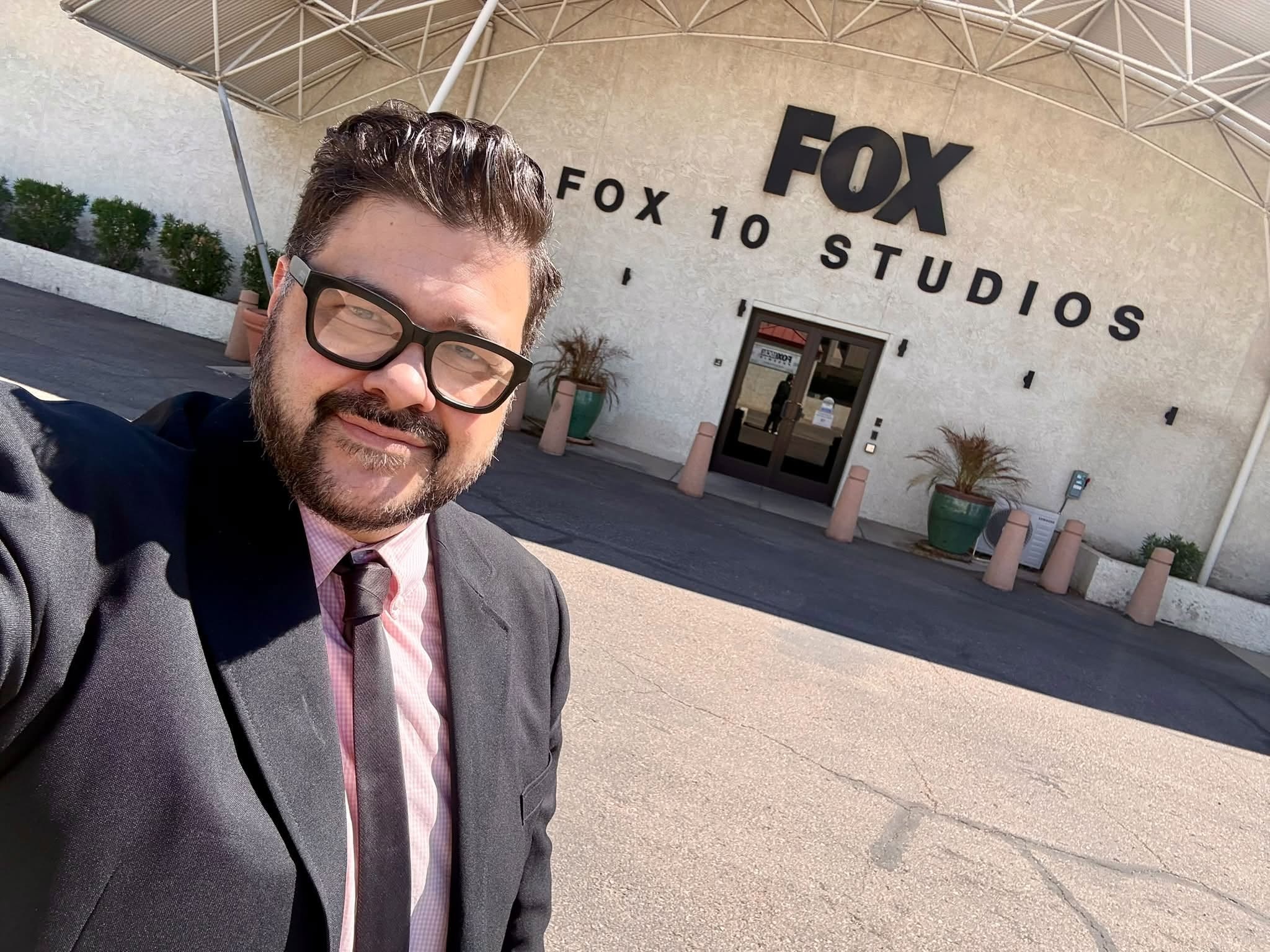

From the early days of Scriptnotes to Disney television and child-development research, Stuart Friedel has built a career around a deceptively complex question: what does responsible storytelling for young people actually require?
Hollywood careers are often described through titles.
Writer.
Producer.
Development executive.
Researcher.
Mentor.
The problem with that approach is that some careers make considerably more sense when viewed through the ideas connecting those titles rather than the titles themselves.
Stuart Friedel is one of those cases.
His résumé crosses television writing, producing, screenwriting education, children’s media, development, academic research, and mentorship. He has written for series including Vampirina, Puppy Dog Pals, Clifford the Big Red Dog, Alice’s Wonderland Bakery, Dr. Seuss’s Horton! and PAW Patrol. He served as a co-executive producer of Apple TV+’s Hello, Jack! The Kindness Show. Long before those credits, he was the first producer of John August and Craig Mazin’s influential screenwriting podcast Scriptnotes.
Then, after establishing himself professionally in the entertainment industry, Friedel returned to graduate school to study child development.
At first glance, these may look like separate chapters.
They are not.
They form a remarkably coherent career built around stories, children, learning, and the responsibilities that come with creating entertainment for young audiences.
Before the Writing Credits
Friedel’s path into television was shaped by both media studies and production training.
A graduate of Pomona College, where he studied Media Studies, he later completed USC’s Peter Stark Producing Program, one of the industry’s better-known graduate programs for producing and entertainment-business training.
That combination matters.
Writers are often trained primarily to think in terms of character, dialogue, structure, and theme.
Producing training introduces another set of questions.
Who is the audience?
How is the project developed?
What does the network need?
How does an idea move from concept to production?
How do creative, financial, logistical, and institutional considerations interact?
Friedel’s later career would repeatedly occupy that intersection.
Even some of his earliest documented work points toward the area in which he would eventually specialize. He worked as a co-producer on Speedy Delivery, a documentary about David Newell, known to generations of viewers as Mr. McFeely from Mister Rogers’ Neighborhood.
Children’s media was not yet the center of his career.
But it was already nearby.
Learning Hollywood from the Development Side
Following graduate school, Friedel worked in Original Programming Development at Disney Channel, giving him early exposure to the way youth programming is conceived and evaluated before it reaches production.
Development is one of the less visible parts of television, but it can be one of the most instructive.
Writers see scripts.
Development professionals see the machinery around them.
They learn how executives respond to pitches, how concepts change through notes, why some projects advance while others stall, and how a network thinks about audience, tone, brand, and programming strategy.
For someone already interested in children’s television, the experience provided something difficult to learn from writing alone: a view of how youth entertainment is shaped institutionally.
That background would later become especially relevant as Friedel moved from helping develop other people’s work to writing and producing children’s television himself.
Becoming Part of Scriptnotes History
In 2011, Friedel joined screenwriter John August as his assistant.
The role became far more consequential than a conventional assistantship.
That same year, August and screenwriter Craig Mazin launched a new podcast about screenwriting.
It was called Scriptnotes.
Friedel became its first producer.
The show would eventually become one of the most influential long-running resources for professional and aspiring screenwriters, covering structure, dialogue, credits, development, contracts, industry practice, creative process, and the realities of working as a screenwriter.
Friedel was there at the beginning.
His role extended far beyond recording episodes.
He worked behind the scenes on production, listener communication, editing, transcripts, episode logistics, the show’s recurring Three Page Challenge, and the considerable administrative work required to turn informal conversations between two screenwriters into a dependable weekly program.
Because his name was mentioned frequently on air while he himself remained mostly unheard, Friedel gradually became something unusual in podcast culture:
a recognizable off-mic personality.
Listeners knew his name.
The hosts joked about him.
His unseen presence became part of the show’s mythology.
John August would later refer humorously to something resembling a “cult of Stuart.”
For someone who was not initially intended to be an on-air character, Friedel had become part of Scriptnotes culture simply through repetition, competence, and the role he played behind the curtain.
The “Stuart Special”
Friedel’s name even entered the show’s screenwriting vocabulary.
While helping select submissions for the Three Page Challenge, he noticed a recurring screenplay opening:
A dramatic or attention-grabbing sequence occurs first, only for the story to jump backward in time and explain how the characters arrived there.
The structure became known on the show as a:
“Stuart Special.”
The term outlasted his tenure.
Years later, writers continued using it, sometimes without knowing the person whose name had originally inspired it.
That small piece of screenwriting jargon is an unusual kind of legacy.
It reflects the extent to which Friedel had become embedded in a community he was ostensibly supporting from behind the scenes.
Teaching Screenwriting Without Being the Teacher
His work around John August also expanded beyond the podcast.
Friedel became heavily involved in Screenwriting.io, an educational resource designed to answer practical questions aspiring screenwriters regularly search online.
How long should a screenplay be?
How should a writer format a specific element?
What does a particular industry term mean?
What should a new screenwriter expect?
Questions that professionals may consider basic are often exactly the questions beginners most urgently need answered.
Friedel helped build a substantial archive addressing hundreds of them.
The material was later consolidated into a free guide covering frequently asked screenwriting questions, with August publicly crediting Friedel for much of the writing behind the resource.
It was an interesting form of education.
Friedel was not presenting himself as a guru.
He was doing something potentially more useful:
making professional knowledge accessible.
That tendency toward practical guidance and mentorship would continue elsewhere in his career.
Choosing Children’s Television
By the time Friedel left his full-time role at August in 2016, the direction he wanted to pursue was clear.
During his Scriptnotes exit interview, he described children’s television as:
“my life’s work. My passion.”
It is an unusually definitive statement.
Many writers enter children’s television because it offers an available opportunity.
Friedel had been moving toward it deliberately.
His later credits make that commitment visible.
He wrote for Disney Junior’s Puppy Dog Pals.
Then came Vampirina.
He contributed to Clifford the Big Red Dog.
Eventually he joined the writing team behind Alice’s Wonderland Bakery, one of Disney Junior’s contemporary reimagining’s of a classic property.
These shows differ in characters, settings, and tone, but they share an important creative challenge.
Writing for very young audiences is not simply writing adult stories with simpler vocabulary.
The emotional architecture has to work differently.
The stakes have to be legible.
Conflicts must be understandable without becoming emotionally overwhelming.
Lessons cannot feel like lectures.
Characters need agency while remaining developmentally believable.
Humor must operate at multiple levels because children and parents are often watching together.
And stories have to resolve in ways that feel emotionally satisfying without pretending that mistakes, fear, jealousy, uncertainty, or disappointment do not exist.
That is specialized writing.
Friedel increasingly made it his specialty.
Storytelling with Social-Emotional Purpose
The clearest indication of Friedel’s creative direction may be the projects that move beyond entertainment toward explicitly prosocial storytelling.
He served as co-executive producer of Hello, Jack! The Kindness Show, the Apple TV+ children’s series starring Jack McBrayer.
The series is built around kindness, empathy, cooperation, and community.
Those themes are easy to describe.
They are considerably harder to dramatize effectively.
A program about kindness can become didactic very quickly if every story is merely designed to deliver a lesson.
The more difficult task is to create characters and situations in which the lesson emerges naturally from action.
That distinction matters because children often recognize emotional authenticity even when they lack the language to articulate it.
The strongest youth programming does not simply tell viewers how to behave.
It shows them characters navigating situations that help them understand why certain choices matter.
That approach has become increasingly central to Friedel’s professional identity.
Building Wonderland for a New Generation
His work on Alice’s Wonderland Bakery brought together several aspects of that philosophy.
Inspired by the world of Alice in Wonderland, the series reframes Wonderland around food, creativity, friendship, collaboration, and community.
Friedel contributed extensively to the series as a writer and staff writer, with credits across numerous episodes and story segments.
He also received lyric-writing credits.
That detail is revealing.
Children’s television often requires writers to move fluidly between conventional storytelling and other narrative forms.
A song is not merely an interruption.
At its best, it can condense character development, emotion, exposition, or thematic meaning into something memorable enough for a young viewer to carry away from the episode.
Writing effectively for preschool audiences therefore demands versatility.
Dialogue.
Story structure.
Comedy.
Repetition.
Music.
Emotional clarity.
Friedel’s work across those areas suggests a writer increasingly comfortable with the specific mechanics of early-childhood storytelling.
Why Child Development Became the Next Step
Then Friedel made a career move that distinguishes him from many television writers.
He returned to university.
At the University of Minnesota’s Institute of Child Development, he completed a master’s degree focused on developmental science.
For someone already professionally established in children’s entertainment, the decision is striking.
He had already learned how to write for young audiences.
He wanted to understand them more deeply.
His research has focused in part on healthy developmental trajectories for young actors working in entertainment.
The connection is important.
Children’s media generally asks two separate questions.
What effect does the content have on the child watching?
And what happens to the child helping create that content?
Hollywood has historically devoted far more attention to the first than the second.
Young performers work in adult professional environments while still undergoing cognitive, emotional, educational, and social development.
Their circumstances can involve pressures that ordinary developmental frameworks were not designed to accommodate:
public visibility,
irregular schedules,
adult expectations,
financial consequences,
performance evaluation,
social-media exposure,
and the possibility of professional identity forming before personal identity is fully developed.
Friedel’s research interest places him at an intersection where entertainment practice and developmental science genuinely need one another.
From Practitioner to Researcher
This later academic work also changes how his television career is understood.
He is not simply a researcher studying children’s media from the outside.
He has sat in writers’ rooms.
He has produced television.
He understands network development.
He has worked directly inside the machinery responsible for turning ideas into programming.
That practical experience gives him context many purely academic researchers do not possess.
Conversely, formal study in child development gives him a framework that many entertainment professionals never acquire.
That combination can produce better questions.
What does a young audience actually understand from a story?
How should emotional conflict be calibrated?
How does representation influence identity development?
What does responsible treatment of young performers look like?
Where does entertainment end and developmental influence begin?
These are not abstract questions for someone whose career has occupied both sides of the divide.
UCLA and Youth Media Representation
Friedel’s work with the Center for Scholars & Storytellers, affiliated with UCLA, further connects those disciplines.
His involvement as a content advisor and youth-media specialist places him within a broader movement attempting to bring research into closer conversation with entertainment professionals.
That bridge matters.
Academic findings do not automatically become useful television.
Writers cannot simply insert psychological research into scripts and expect compelling storytelling to emerge.
At the same time, entertainment creators who ignore developmental research risk making assumptions about young audiences based largely on instinct.
The most productive work happens when those groups understand one another.
A writer who understands research can help translate it into story.
A researcher who understands production can frame findings in ways creators can realistically apply.
Friedel’s career increasingly sits inside that translation layer.
Mentorship as a Consistent Thread
The same emphasis appears in his volunteer work.
Friedel has been involved with Young Storytellers, helping elementary-school students develop stories and experience the creative process.
He has also remained active with Pomona College, eventually serving in alumni leadership.
Neither role is directly necessary for a television career.
But both fit the larger pattern.
Again and again, Friedel has participated in environments designed to help younger or less experienced people understand storytelling, access creative opportunities, or build confidence inside unfamiliar professional systems.
From answering basic screenwriting questions online to mentoring school-age storytellers, education has repeatedly operated alongside his entertainment work rather than separately from it.
Returning to Scriptnotes
Friedel eventually returned to Scriptnotes as a guest for its milestone 700th episode, where John August again introduced him as the program’s first producer.
The appearance carried a certain symmetry.
A person who had spent years helping to construct a resource for screenwriters from behind the microphone had since built the writing career he had been pursuing.
By then, Friedel’s path had expanded considerably beyond the assistant desk where Scriptnotes began.
He had become a professional television writer.
A producer.
A graduate researcher.
A youth-media advisor.
And a specialist in the exact area of storytelling he had described years earlier as his life’s work.
Still Writing
The academic turn has not replaced television.
Friedel continues to accumulate writing credits, including recent work on Dr. Seuss’s Horton! and a credited 2026 contribution to PAW Patrol.
That ongoing creative work is important.
He is not someone who left entertainment in order to study it.
He remains a practitioner.
That makes the relationship between research and storytelling much more immediate.
Every writers’ room provides another opportunity to test what responsible youth storytelling looks like in practice.
Every episode carries the constraints that academic theory does not encounter:
runtime,
network notes,
budget,
character continuity,
brand expectations,
humor,
music,
production schedules,
and the basic requirement that children actually enjoy watching the program.
Research can inform those decisions.
It cannot replace creative judgment.
Friedel’s career increasingly appears built around integrating the two.
A Different Kind of Children’s Television Career
There is a tendency to underestimate children’s programming because its surface simplicity can hide the sophistication required to make it work.
Young audiences are less experienced viewers.
That does not make them less demanding.
They notice boredom quickly.
They repeat stories obsessively.
They absorb character behavior.
They attach emotionally to fictional worlds.
And they often encounter ideas through entertainment long before they encounter those same ideas formally in school.
That gives children’s television unusual power.
It also gives creators unusual responsibility.
Friedel’s professional trajectory suggests that he takes both seriously.
The progression is unusually logical when viewed in full.
He studied media.
He learned producing.
He worked in children’s development.
He helped build one of the screenwriting community’s most influential educational resources.
He became a professional children’s television writer and producer.
Then he studied child development so that his understanding of young people would extend beyond intuition and industry convention.
What looks like a collection of different careers is actually one increasingly specific pursuit?
The Story Behind the Credits
A television résumé can tell you what someone has worked on.
It rarely tells you what they are trying to understand.
For Stuart Friedel, the more revealing question is not simply which programs carry his name.
It is why so many different parts of his career keep returning to the same subjects:
stories,
learning,
children,
development,
mentorship,
and the systems through which entertainment reaches young people.
His work sits at an unusual intersection of creativity and responsibility.
He understands television as a writer.
He understands production as a producer.
He understands new writers because he spent years helping answer their questions.
And increasingly, he understands young audiences through the language of developmental science as well as storytelling instinct.
That combination gives his career a coherence that is easy to miss if one looks only at individual credits.
Friedel once described children’s television as his life’s work.
Years later, the phrase appears less like an early ambition and more like an accurate description of the career he has methodically constructed.
For Friedel, writing for children has never meant merely making television that young people can watch.
It means understanding who they are, how they grow, and what responsibility belongs to the people creating stories for them.